
In the context of the creation of the climate change issue and the related cooperation of the students of the L.T. Gymnasium schools, Paranestiou Dramas (Greece) and Socrates Academy, N.Carolina (USA), a very interesting educational briefing on the phenomenon of the climate crisis was held, with the Professor of Environmental Chemistry of the University of Crete and researcher at the Institute for Environmental Research and Sustainable Development of the National of the Athens Observatory, Mr. Michalopoulos N, who directly and validly responded to our common concerns.
The main points, supported in part by a few relevant images, are illustratively presented below, in the form of questions and answers.
Climate change, myth or reality?
The climate crisis is here. It results in major climate-related natural disasters. Already lot has happened in Greece. It is an issue that concerns all of us and especially the new generations.
What are the consequences of the climate crisis?
The main consequences concern both human losses (which with existing technological tools have fortunately been reduced enough), as well as environmental, social and economic impacts, estimated at around $1 trillion in the decade 2005-2014, globally.
Has man affected the climate and how much?
The sun is a source of life for our planet. Its radiation in combination with earth’s atmospheric composition are responsible for the natural phenomenon of the greenhouse effect and the maintenance of life on our planet. Indeed the infrared radiation emitted by the Earth, resulting from sun warming, is absorbed in the atmosphere by some gases, the so-called greenhouse gases. These gases (H2O, CO2, CH4) naturally warmed the atmosphere, by about 330C, creating an appropriate average temperature (150C instead on -180C).
natural greenhouse effect

However, the concentration of these gases in the atmosphere has increased dramatically since the industrial revolution, as a result of which they capture more and more heat, so we now refer to the anthropogenic greenhouse effect that has already and continues to increase the average temperature of the Earth (actually by 1,10C on a global basis).
These greenhouse gases have the ability to remain in the Earth’s atmosphere for many years (about 50-100 years for CO2) before being removed. So the climate crisis concerns not only today, but also the next generations mainly which should be informed.

What are the main environmental consequences of the climate crisis?
First of all, an increase in average temperature, decrease in rainfall (almost 30% in the Mediterranean), increased drought, increased risk of fires, transmission of diseases by mosquitoes or pests, melting ice, rising sea levels etcs.
Has the Mediterranean been affected by the climate crisis?
The Mediterranean is a «Hot Spot» region. In the last 40 years the temperature in this area has been increased significantly. If we do not act immediately on the problem of the climate crisis, in the future the temperature in the Mediterranean could rise by up to 5 degrees Celsius.
Mediterranean – temperature variation

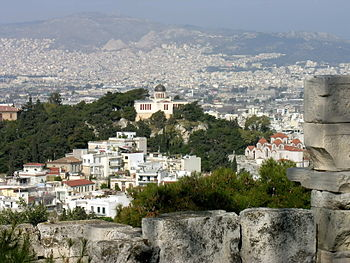
In Greece, especially in Athens, from the 1980s until today the temperature has been increased by at least 2 degrees Celsius, according to the continuous scientific measurements of the National Observatory of Athens, which is the oldest research center in Greece (1842).
National of the Athens Observatory
If we do not deal with the climate crisis, is there an estimate of how Greece could be affected in the coming years?
According to relevant research and scientific models, if the climate crisis is not addressed, the maximum summer temperature will increase mainly inland by up to 2.5 degrees C in 2021-2050 and up to 5 degrees C in 2071-2100. Smaller changes will occur in the islands and coastal areas of Eastern Greece mainly. Increase of the hot season for more than a month (40 days) are expected with increased risk of fires and particularly high energy requirements for cooling, for the periods up to 2050 initially and 2071-2100, with a decrease in rainfall in Greece with emphasis on eastern Greece (Crete and Peloponnese the most). That is why it is important to understand that the climate crisis is a global, generational issue.
Is everyone equally responsible for the phenomenon of the climate crisis?
No, the major industrialized countries have the significantly larger share in CO2 emissions. But the implications concern all parts of the Earth.
How can we contribute to tackling the climate crisis?
Indicatively, we can mention several ways. First of all, to reduce the use of fossil fuels and increase the use of renewable energy sources. Let’s think about the consumption model that best fits this situation. To use environmentally friendly means of transport wherever possible. To make small but smart energy-saving changes (e.g. use of LED lamps). To be also environmentally aware and informed. And always think on solidarity among humans as climatic crisis concerns our earth, thus all.
