
By Spiros Pelekas.
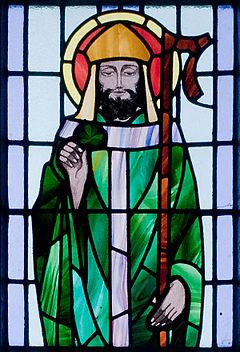
Saint Patrick’s Day, or the Feast of Saint Patrick, is a religious and cultural holiday held on 17 March, the traditional death date of Saint Patrick (c. 385 – c. 461), the foremost patron saint of Ireland. Saint Patrick’s Day was made an official Christian feast day in the early 17th century and is observed by the Catholic Church, the Anglican Communion the Eastern Orthodox Church, and the Lutheran Church. The day commemorates Saint Patrick and the arrival of Christianity in Ireland, and, by extension, celebrates the heritage and culture of the Irish in general. Celebrations generally involve public parades and festivals, céilithe, and the wearing of green attire or shamrocks. Christians who belong to liturgical denominations also attend church services and historically the Lenten restrictions on eating and drinking alcohol were lifted for the day, which has encouraged and propagated the holiday’s tradition of mass alcohol consumption. Saint Patrick’s Day is a public holiday in the Republic of Ireland, Northern Ireland, the Canadian province of Newfoundland and Labrador (for provincial government employees), and the British Overseas Territory of Montserrat. It is also widely celebrated in the United Kingdom, Canada, United States, Argentina, Australia, South Africa, and New Zealand, especially amongst Irish diaspora. Saint Patrick’s Day is celebrated in more countries than any other national festival. Modern celebrations have been greatly influenced by those of the Irish diaspora, particularly those that developed in North America. However, there has been criticism of Saint Patrick’s Day celebrations for having become too commercialised and for fostering negative stereotypes of the Irish people.

Saint Patrick was a 5th-century Romano-British Christian missionary and Bishop in Ireland. Much of what is known about Saint Patrick comes from the Declaration, which was allegedly written by Patrick himself. It is believed that he was born in Roman Britain in the fourth century, into a wealthy Romano-British family. His father was a deacon and his grandfather was a priest in the Christian church. According to the Declaration, at the age of sixteen, he was kidnapped by Irish raiders and taken as a slave to Gaelic Ireland. It says that he spent six years there working as a shepherd and that during this time he found God. The Declaration says that God told Patrick to flee to the coast, where a ship would be waiting to take him home. After making his way home, Patrick went on to become a priest.
Tradition holds that he died on 17 March and was buried at Downpatrick. Over the following centuries, many legends grew up around Patrick and he became Ireland’s foremost saint.
Present day Saint Patrick’s Day celebrations have been greatly influenced by those that developed among the Irish diaspora, especially in North America. Until the late 20th century, Saint Patrick’s Day was often a bigger celebration among the diaspora than it was in Ireland.
Celebrations generally involve public parades and festivals, Irish traditional music sessions (céilithe), and the wearing of green attire or shamrocks. There are also formal gatherings such as banquets and dances, although these were more common in the past. Saint Patrick’s Day parades began in North America in the 18th century but did not spread to Ireland until the 20th century. The participants generally include marching bands, the military, fire brigades, cultural organisations, charitable organisations, voluntary associations, youth groups, fraternities, and so on. However, over time, many of the parades have become more akin to a carnival. More effort is made to use the Irish language, especially in Ireland, where 1 March to St Patrick’s Day on 17 March is Seachtain na Gaeilge («Irish language week»).
Since 2010, famous landmarks have been lit up in green on Saint Patrick’s Day as part of Tourism Ireland’s «Global Greening Initiative» or «Going Green for St Patrick’s Day». The Sydney Opera House and the Sky Tower in Auckland were the first landmarks to participate and since then over 300 landmarks in fifty countries across the globe have gone green for Saint Patrick’s Day.
Christians may also attend church services, and the Lenten restrictions on eating and drinking alcohol are lifted for the day. Perhaps because of this, drinking alcohol – particularly Irish whiskey, beer, or cider – has become an integral part of the celebrations. In Ireland, this relaxation of fasting rules is notably marked by the consumption of stout, a dark ale beer that is a key part of the celebration, with breweries preparing months in advance for the demand. The Saint Patrick’s Day custom of «drowning the shamrock» or «wetting the shamrock» was historically popular. At the end of the celebrations, especially in Ireland, a shamrock is put into the bottom of a cup, which is then filled with whiskey, beer, or cider. It is then drunk as a toast to Saint Patrick, Ireland, or those present. The shamrock would either be swallowed with the drink or taken out and tossed over the shoulder for good luck.
